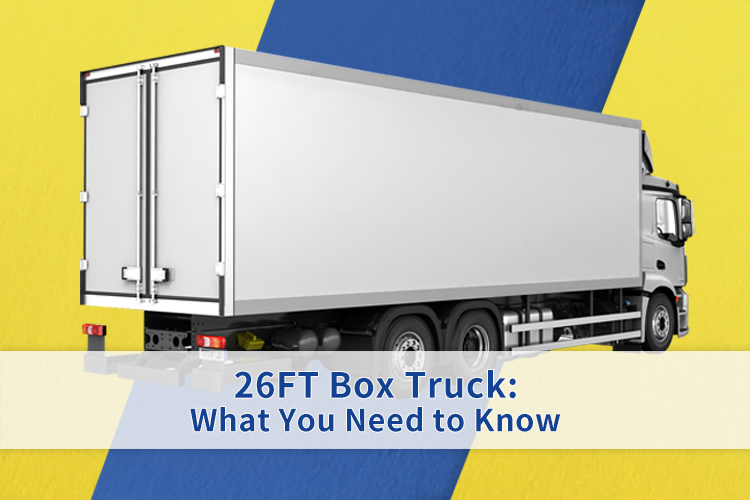
26FT Box Truck: What You Need to Know
What is a 26 foot box truck?
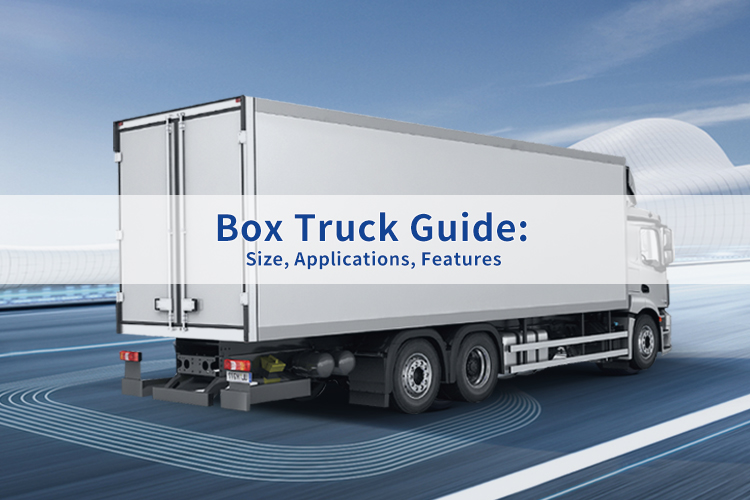
The 26-foot box truck is a common enclosed transport vehicle, available as either a dry van or reefer, also known as a straight truck. Its cargo box and cab are mounted on the same chassis, differing from semi-trailers and full trailers. This integrated design offers greater maneuverability and enhanced adaptability for urban roads.
The 26-foot body measures approximately 7.9 meters in length, with a height ranging from 12.5 to 13.5 feet. Its payload capacity typically falls between 11,000–16,000 pounds, and the common gross vehicle weight rating is about 27,000 pounds. Many configurations operate within legal limits without requiring a Commercial Driver’s License (CDL), simplifying scheduling and staffing. Equipped with roll-up doors, side doors, and power liftgates for loading/unloading, 26-foot box trucks are widely used for moving services, furniture delivery, supermarket restocking, food service distribution, and building materials transport.
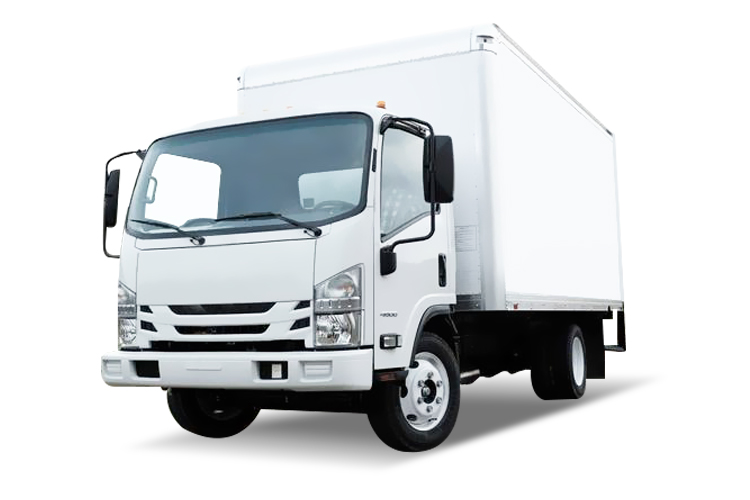
Features of 26 ft box truck
Size: 26 ft vans are 26 ft in length, which is about 7.9 meters, and between 12.5 and 13.5 ft in height.
Driving Requirements: No Commercial Driver’s License, also called a CDL, required for easy driving
Load Capacity: Loads range from 10,000 to 17,000 pounds, with a typical gross vehicle weight rating of 26,000 pounds
Suspension: Air or heavy-duty spring suspension is used.
Drive type: generally rear-wheel drive or all-wheel drive, with all-wheel drive configurations adding to the cost.
Uses of a 26-foot box truck
The 26-foot box truck is very versatile and can transport both small and large objects.
Furniture items distribution: 26 foot moving truck is the most popular, he can move 4 to 7 rooms and can move items such as beds, refrigerators, televisions and sofas.
Flower and Greenery Delivery: Converted into a flower truck, it can transport greenery, potted plants, flowers and so on.
Building Materials Transportation: Can transport building materials such as pipes, tiles, and sheets.
Catering delivery: It can deliver food, vegetables, seasonings, etc. for restaurants and cafeterias.
Retail replenishment: can replenish inventory for small supermarkets, large superstores, and can be easily parked in loading zones.
How many boxes can a 26-foot truck hold?
How many boxes can be loaded depends on the size of the boxes. Generally speaking, a 26-foot truck has a volume of about 33 cubic meters and can hold 300~400 standard 18x18x16-inch cartons.
The standard pallet loading configuration for a 26-foot box truck is typically arranged as “2 across × 6–8 rows.” A single layer can accommodate approximately 12 to 16 standard 48“ × 40” pallets. When employing the cubic packing method, the truck’s total volume is approximately 33 cubic meters. The estimated quantity can be calculated based on container volume: 0.5 cubic meters holds about 85 pieces, 0.25 cubic meters holds about 170 pieces, and 0.1 cubic meters holds about 425 pieces. Actual loading quantities must account for void space and securing requirements.
| Box Size | Volume of a Single Box | Approx. No. of Boxes |
|---|---|---|
| 1 cubic meter | 1 cubic meter | 42 – 43 pieces |
| 0.5 cubic meter | 0.5 cubic meter | About 85 pieces |
| 0.25 cubic meter | 0.25 cubic meter | About 170 pieces |
| 0.1 cubic meter | 0.1 cubic meter | 425 pieces |
| 0.05 cubic meter | 0.05 cubic meter | 850 pieces |
Who Uses 26-Foot Box Trucks?
You’ll commonly see 26-foot box trucks used by:
- Moving and storage companies
- Retail chains and furniture delivery
- Independent freight drivers
- Rental agencies offering 26-foot box truck rental
Materials and Components of the 26-Foot Container
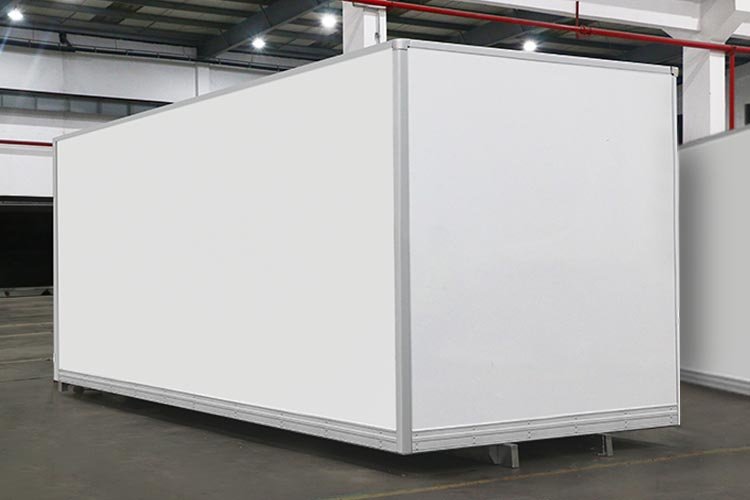
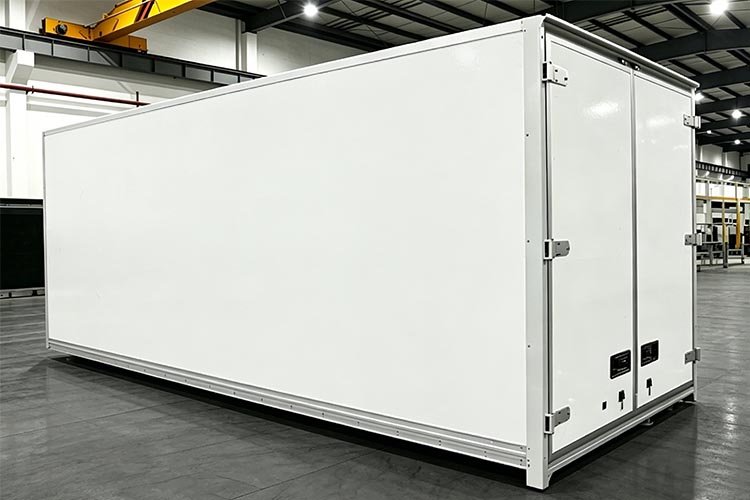
The 26-foot box body typically incorporates materials such as fiberglass skins and plywood. The FRP skin offers impact resistance, waterproofing, and corrosion resistance. During subsequent maintenance, this material is easy to maintain and clean, making it suitable for outdoor environments. The plywood used in 26-foot box trucks provides superior compression strength and impact resistance.
To date, the vast majority of cargo bodies are manufactured using composite materials, incorporating sandwich cores. Both foam and PP honeycomb cores are popular choices, enhancing load-bearing capacity and durability. Additionally, rigid foams like XPS, PU, PET, and PVC are employed for insulation or cost/recyclability considerations, catering to refrigerated or dry cargo requirements.
In common logistics transport vehicles, the body combines sandwich panels for the roof, side panels, and rear door to form a rigid outer shell. Common thickness ranges and densities are determined by different materials and applications (e.g., GRP honeycomb panels offer multiple thicknesses and core densities to match load and insulation requirements). The integrated design significantly reduces vehicle weight while enhancing impact resistance. Compared to traditional metal bodies, this approach achieves substantial weight reduction, thereby lowering fuel consumption and improving economic efficiency.

How many pallets can a 26-foot box van hold?
A 26-foot box truck can hold 12~16 standard pallets. The size of the pallet is 48 inches x 40 inches, and we use a sensible placement method, placing 2 pallets side by side, and 6 to 8 lengthwise. This is a single tier placement.
FAQ
How tall is a 26-foot box truck?
A 26-foot box truck typically stands between 12.5–13.5 feet tall, approximately 3.8–4.1 meters, making it suitable for most loading docks and urban height restrictions.
How long is a 26-foot box truck?
“26 feet” generally refers to a cargo box length of approximately 26 feet (about 7.9 meters). The overall vehicle length may vary slightly depending on cab and bumper design.
How much weight can a 26-foot box truck carry?
Most 26 ft box trucks can carry 9,000 to 10,000 pounds of payload, depending on the make and model.
To calculate how much weight you can haul:
Payload Capacity = GVWR – Empty Truck Weight
How wide is a 26-foot box truck?
The interior width of this truck typically allows two 48×40-inch pallets to be placed side-by-side, making a 2-deep layout common for maximizing loading efficiency.
What is the cubic footage of a 26-foot box truck?
A 26-foot box truck commonly has a volume of approximately 33 cubic meters, which converts to about 1,165 cubic feet. Actual usable volume must account for deductions due to the tailgate and fixed structural components.
What is the typical price range for a 26-foot box truck?
Prices vary significantly based on factors such as age, chassis model, refrigeration capability, configuration, and customization level. It is recommended to contact dealers or truck dealerships for specific quotes.
Related Posts

Related Product

Author introduction

Hello, customers
My name is Jack Yu and I am the Business Manager of Composite Box. I have been in the business of sandwich panels, refrigerated trucks and RVs for more than 10 years. Please feel free to contact us. I am happy to provide you with the best service and products.
Email: info@composite-box.com




 English
 French
 German
 Japanese
 Korean
 Russian
 Polish
 Spanish