
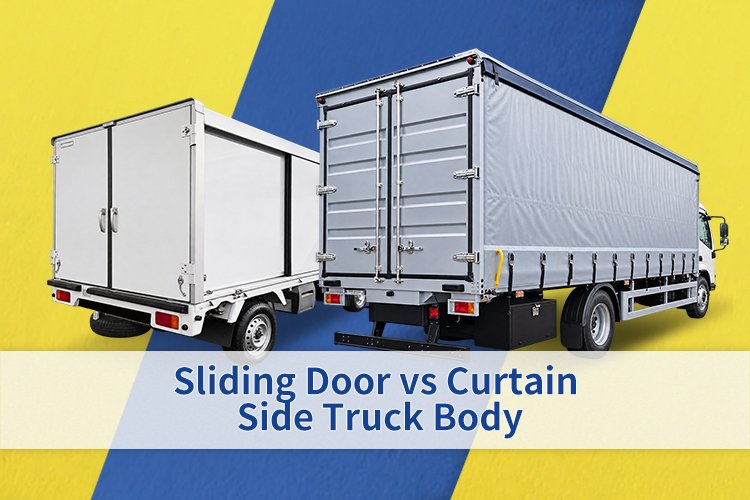
Sliding Door vs Curtain Side Truck Body: Which Offers Better Accessibility
In the commercial transport sector, loading and unloading efficiency significantly impacts delivery schedules, labor costs, and overall fleet productivity. The design of a truck body largely determines how easily cargo can be accessed during transport. Among the common types of truck bodies, sliding-door and curtain-side configurations offer two distinct solutions for side-access loading and unloading.
While both designs provide a convenient alternative to traditional rear-door loading, they differ in terms of opening range, operating mechanisms, loading flexibility, and ideal use cases. So, which one offers greater convenience for accessing cargo? Let’s compare their structures and practical performance.
What is a sliding-door truck body?
A sliding-door truck body is equipped with rigid side doors that move horizontally along a track. Unlike traditional hinged doors, these doors open by sliding to one side, allowing personnel to access cargo through a specific opening on the vehicle’s side.
Key components typically include door panels, guide rails, rollers, locking mechanisms, and a supporting frame. Depending on the specific design, sliding doors can be installed on one or both sides of the vehicle.
A major advantage of this structure is that it requires no extra space for doors to swing outward. Consequently, it is highly suitable for urban deliveries, warehouse operations, and loading areas where operating space is limited.
However, the accessible opening is generally constrained by the door structure and the available sliding space. If cargo is positioned deep within the truck body, personnel may need to move or rearrange other items to reach the specific goods they require.
What is a curtain-side truck body?
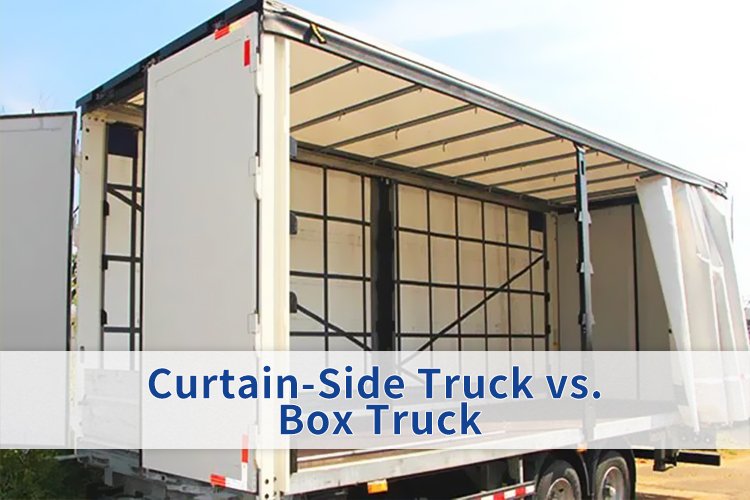
A curtain-side truck body replaces traditional rigid side doors with flexible, PVC-coated fabric curtains. These curtains are suspended from an overhead rail system and secured at the bottom using tensioning devices, buckles, or fastening straps.
To open the side, personnel simply release the fastening system and slide the curtain along the rail. Depending on the design, the movable vertical posts along the sides of the cargo body can be repositioned or removed, creating a larger opening for loading and unloading.
This configuration provides extensive access to the interior of the cargo space, making curtain-sided vehicles particularly well-suited for transporting palletized goods, construction materials, and various industrial products. Unlike traditional rigid-sided cargo bodies, the curtain-sided design allows forklifts to approach the cargo directly from the side. This reduces unnecessary handling steps and enhances loading and unloading efficiency—a benefit that is especially significant when multiple delivery points are involved.
Sliding-Door vs. Curtain-Sided Cargo Bodies: Key Differences
While both designs allow for side access to cargo, their structural differences influence daily transport operations.
| Comparison Dimension | Sliding-Door Cargo Body | Curtain-Sided Cargo Body |
|---|---|---|
| Opening/Closing Mechanism | Rigid sliding panels | Flexible sliding curtains |
| Opening Area | Limited by the dimensions of the door | Typically offers a wider side opening |
| Loading/Unloading Flexibility | Access restricted to specific openings | Allows access across a large area of the side |
| Forklift Operations | Dependent on the size of the door opening | Facilitates easier side loading and unloading |
| Space Requirements | Requires clearance for the sliding doors | Requires space for the curtains to be retracted |
| Protection/Security | Rigid panels provide a robust barrier | Depends on the quality and sealing of the curtains |
| Maintenance | Involves tracks, rollers, and door locks | Involves curtains, rollers, straps, and tensioning devices |
| Typical Applications | Urban distribution and general cargo transport | Palletized goods and industrial transport |
The primary distinction is that sliding-door cargo bodies provide access through specific openings, whereas curtain-sided cargo bodies allow for a large portion of the side to be opened completely.
Which body structure offers greater convenience for loading and unloading?
Determining which design excels in terms of loading and unloading convenience requires a comprehensive assessment of several practical factors.
Convenience of Side Loading and Unloading
When a large side opening is required, curtain-sided bodies (curtainsiders) generally offer a distinct advantage. Operators can retract the side curtains to expose a significant portion of the cargo space, making it easier to load or unload goods from various positions.
In contrast, bodies equipped with sliding side doors rely on pre-defined openings. While this design is suitable for smaller-scale operations or specific access points, the size of the opening may impose limitations when handling large or bulky cargo.
Efficiency of Forklift Operations
The ease of using a forklift is another critical consideration. Curtainsiders are exceptionally well-suited for forklift operations, as their expansive side openings allow forklifts to place pallets directly into the cargo area.
This is particularly advantageous in distribution centers and industrial warehouses where loading and unloading speed is paramount.
Bodies with sliding side doors also accommodate forklift operations, though their efficiency depends on the size and placement of the openings. Smaller openings may necessitate additional maneuvering or the repositioning of cargo.
Flexibility in Loading and Unloading
Flexibility is essential for transport operations that involve multiple delivery stops.
Curtainsiders allow operators to load or unload from various sections of the cargo space, rather than relying solely on the rear doors. Some systems even support partial opening, enabling access to a specific area while keeping the rest of the cargo space covered and protected.
Conversely, bodies with sliding side doors are better suited for scenarios where loading and unloading occur at specific, predetermined locations and follow a relatively fixed process.
Operational Space and Ease of Use
Sliding side doors do not swing outward, which is highly beneficial in confined loading areas; however, they do require sufficient track space to allow the door panels to slide open.
Similarly, curtainsiders do not require traditional outward-swinging doors. Nevertheless, operators need adequate space alongside the vehicle to retract and secure the side curtains during the loading or unloading process. For operations that frequently require side loading and unloading, a curtain-side design typically offers greater flexibility.
Application Scenarios: How to Choose the Right Design?
The choice of vehicle body structure depends on the nature of the cargo, the frequency of loading and unloading, and specific transport requirements.
Sliding-Door (Rigid-Side) Bodies
Suitable for:
- Urban distribution and local transport.
- General packaged goods. Operations that require specific side-access points.
- Businesses that prefer a rigid side-wall structure.
- Curtain-Side Bodies
- These are particularly well-suited for:
- Palletized cargo and packaged products.
- Construction materials and supplies.
- Industrial equipment and automotive parts.
- Logistics operations involving multiple loading and unloading locations.
If your business frequently involves loading or unloading pallets via forklift, or requires access to different sections of the cargo space, a curtain-side body is generally the more practical choice.
The Role of Composite Panels in Truck Body Manufacturing
Ease of access is only one aspect of a vehicle body’s performance. Structural strength, weight, durability, and cargo protection are equally critical.
Composite panels can be used for various rigid components of a curtain-side body, including the front bulkhead, rear doors, and optional rigid side-wall sections.
Fiberglass-reinforced plastic (FRP) sandwich panels feature a durable outer surface and can be combined with various core materials to meet specific structural requirements. Depending on the application, options such as polypropylene (PP) honeycomb cores, PET foam cores, or other lightweight core materials can be utilized.
For vehicle body manufacturers, these materials help optimize structural weight and mechanical performance, while allowing for greater customization.
By selecting the appropriate panels and pairing them with a suitable opening system, manufacturers can create vehicle bodies that strike an ideal balance between ease of access, durability, and transport efficiency.
Conclusion: Which Option Is Better?
Both sliding-door bodies and curtain-side bodies offer practical solutions for side access, yet each is tailored to different operational needs. Sliding-door bodies are well-suited for operations requiring controlled access through a rigid side opening, particularly in urban delivery environments. Curtain-side bodies, by contrast, offer more expansive side access, making them the ideal choice for operations involving frequent forklift loading and unloading, palletized cargo, or multi-stop transport routes.
Ultimately, the best choice depends on the nature of the cargo, the loading and unloading equipment used, the available operational space, and specific transport requirements.
For truck body manufacturers and fleet operators, selecting the appropriate structure—complemented by suitable lightweight composite materials—can help enhance overall vehicle performance and operational efficiency.



 English
 French
 German
 Japanese
 Korean
 Russian
 Polish
 Spanish