
Ambulance Body Manufacturing: Types, Materials, Design, and Performance
Ambulances play a vital role in emergency medical services, not only by providing safe and efficient patient transport, but also by supporting medical personnel during emergency responses, patient care, and inter-facility transfers. The design and manufacturing of an ambulance’s patient compartment directly influence vehicle performance, patient comfort, operational efficiency, and long-term durability.
As ambulance technology continues to advance, manufacturers are increasingly adopting lightweight composite materials—such as fiber-reinforced plastic (FRP) and foam-core sandwich panels—to enhance structural performance and reduce vehicle weight. Compared to traditional metal structures, these materials offer significant advantages in terms of corrosion resistance, thermal insulation, design flexibility, and weight optimization.
Ambulance Body Types and Applications
Ambulances are typically classified based on their vehicle platform, body configuration, and intended medical use. The most appropriate design depends on local regulations, operational requirements, patient capacity, and the available vehicle chassis.
· Type I, Type II, and Type III Ambulances
In the United States, ambulances are generally categorized into three configurations: Type I, Type II, and Type III.
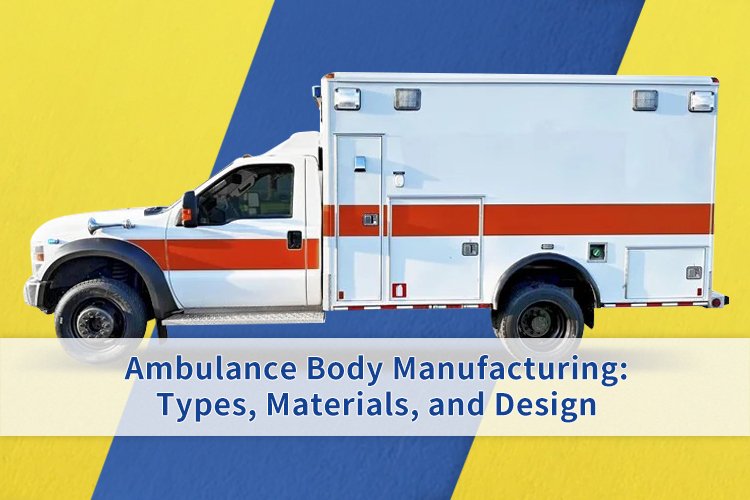
- Type I Ambulances: Built on a truck-style chassis, these feature a separate cab and a modular patient compartment. They are often used for emergency medical services that require a rugged patient compartment, ample space for equipment, and flexible customization of the interior.
- Type II Ambulances: Built on a van chassis, these retain the original van body structure. They are commonly used for patient transport, basic emergency response, and urban medical services where high maneuverability is required.
- Type III Ambulances: Also built on a van chassis, these feature a separate, modular patient compartment connected to the cab via an opening. This design provides more space for medical equipment and allows for a more flexible interior layout.
· Box-Type Ambulances vs. Van-Based Ambulances
Box-type ambulances feature a separate, rectangular medical compartment mounted onto the chassis. The interior is relatively spacious, facilitating the placement of stretchers, storage cabinets, medical equipment, and workstations for medical personnel. The modular structure also allows for customization of dimensions, insulation thickness, and equipment mounting systems.
Van-based ambulances (converted from light van or panel van chassis) typically have a more compact exterior, offering greater maneuverability in congested urban environments, and are built on more widely available vehicle platforms. However, their internal dimensions and body geometry may limit the scope for customization.
· Emergency Response, Patient Transport, and Mobile Medical Applications
The requirements for an ambulance body depend on its specific intended use. Vehicles designed for emergency response must ensure that medical equipment is easily accessible and securely stored, with an interior layout that supports the rapid provision of care to patients. Patient-transport ambulances prioritize convenience, patient comfort, and an efficient process for loading and unloading patients.
Some vehicles are also configured for mobile medical services, vaccination programs, community healthcare, and telehealth support. These use cases may require additional insulation, electrical systems, storage space for medical supplies, and specialized interior facilities.
Common Materials Used in Ambulance Body Manufacturing
The choice of materials influences vehicle weight, structural integrity, durability, maintenance costs, and the working environment within the medical compartment. In this article, we introduce our latest material solutions: fiber-reinforced plastic (FRP) and foam-core sandwich panels.
· FRP Sheets
FRP is a composite material consisting of glass fibers embedded in a polymer resin. It is widely used for body panels, protective enclosures, and various types of specialized transport equipment.
In the manufacturing of ambulances, FRP offers several advantages:
- Corrosion Resistance: Unlike steel, FRP does not rust and can withstand humid conditions and various common environmental factors.
- Design Flexibility: FRP sheets can be produced in a wide range of shapes, thicknesses, colors, and surface finishes.
- Surface Protection: Appropriate gel coats or protective coatings provide a smooth, easy-to-clean surface while enhancing resistance to environmental degradation.
- Weight Optimization: Compared to many traditional materials, FRP offers a superior strength-to-weight ratio.
· Foam-Core Sandwich Panels
For ambulance compartments, FRP foam-core sandwich panels are particularly well-suited for sidewalls, roofs, doors, and certain floor structures. This construction effectively combines the high strength of FRP sheets with the thermal insulation and lightweight properties of a foam core.
Key advantages include:
- Thermal Insulation: The foam core helps minimize heat transfer through the vehicle body, ensuring a more stable internal environment.
- Lightweight and High Rigidity: The sandwich structure achieves excellent flexural rigidity without the need for heavy, solid panels.
- Corrosion Resistance: Properly designed and sealed FRP panels protect the ambulance compartment from corrosion.
- Manufacturing Efficiency: Large, integrated panels reduce the number of individual components and joints required during the assembly process.
Key Structural Design Considerations for Ambulance Box Bodies
The ambulance body must be capable of withstanding road vibrations, braking forces, cornering loads, exposure to the elements, and the repetitive opening and closing of doors. Furthermore, it must provide secure mounting points for medical equipment and patient restraint systems.
· Structural strength and reinforcement are fundamental considerations. High-load areas—such as stretcher attachment points, cabinet mounting locations, door frames, lifting points, and chassis connection interfaces—may require localized reinforcement using engineered inserts, metal profiles, or composite reinforcement layers.
· Panel bonding and joint design are equally critical. Factors such as the choice of adhesive, surface preparation, curing conditions, and bond-line thickness all influence the reliability of the composite structure. Joints and penetrations must be designed to effectively prevent water ingress and ensure that moisture does not reach the core material.
· Floor performance warrants special attention, as the floor must support patients, medical equipment, and concentrated loads from wheels or mounting brackets. Floor panels must be specifically engineered to resist bending, impact, and concentrated loads, while ensuring a robust connection to the chassis.
· Interior layout and ergonomics directly impact medical workflows and patient safety. The positioning of cabinets, climate control systems, and other elements is of vital importance.
Conclusion
Ambulance body manufacturing requires a careful balance of structural strength, low weight, thermal insulation, hygiene, and operational reliability. Type I, Type II, and Type III configurations serve different transportation and emergency response needs, while box-type bodies provide additional flexibility for specialized medical applications.
FRP and foam-core sandwich panels offer manufacturers practical solutions for building lightweight, corrosion-resistant, and well-insulated ambulance compartments. When combined with sound structural engineering, appropriate reinforcement, validated safety systems, and rigorous quality control, composite construction can help improve ambulance efficiency and support reliable long-term service.
For ambulance manufacturers and vehicle converters, selecting the right panel architecture is not simply a material decision. It is an integral part of designing a safe, durable, and efficient emergency medical vehicle.




 English
 French
 German
 Japanese
 Korean
 Russian
 Polish
 Spanish