
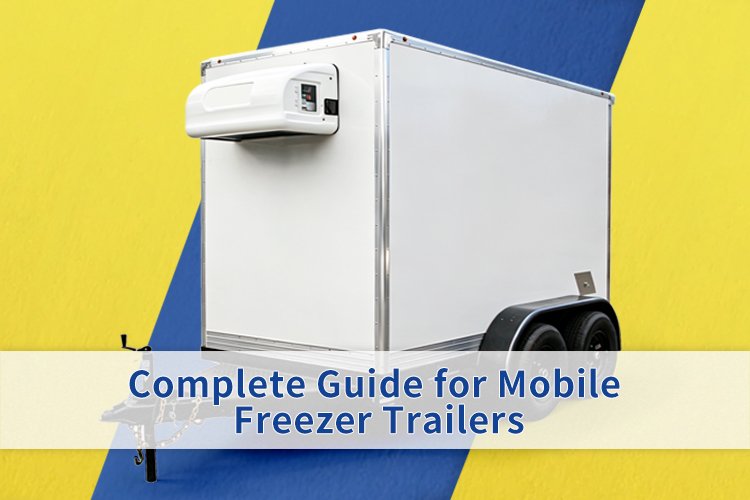
Complete Guide for Mobile Freezer Trailers
Key Points
- Mobile freezer trailers provide flexible and reliable cold storage for transporting and storing frozen products.
- Choosing the right trailer involves more than selecting the size.
- Our customization allows businesses to optimize their freezer trailers for specific applications.
Benefits of Mobile Freezer Trailers
Excellent Temperature Control
Mobile refrigerated trailers maintain a stable low temperature within the cargo compartment, effectively preventing product spoilage. Precise temperature control ensures the cargo remains in optimal condition.
Easy to Transport
It can be relocated at any time, enabling rapid goods response across multiple locations. By eliminating reliance on fixed cold storage facilities, it significantly alleviates your warehousing pressure and management risks.
Lower Operating Costs
It is more cost-effective than constructing a cold storage facility at a fixed location. You do not need to purchase or lease a large-scale cold storage unit, thereby reducing costs associated with temporary needs.
High Energy Efficiency
We recommend using PU/XPS insulation foam for the panel core. The trailer body is lightweight, resulting in higher fuel efficiency and greater energy savings.
Flexible Capacity
We offer a range of trailer sizes, allowing businesses to select the dimensions best suited to their specific storage needs. Extensive customization options are available, covering length, width, and thickness; the number of internal compartments; internal layout and storage configurations; as well as logos and exterior design.
Types of Mobile Freezer Trailers
·Single Axle
·Tandem Axle
·Electric Freezer Trailer
·Diesel Refrigerated Trailer
How to Choose the Right Mobile Freezer Trailer
- Trailer dimensions
- Internal volume
- Payload capacity
- Insulation thickness
- Refrigeration unit
- Temperature range
- Floor material
- Door configuration
- Power supply
- Maintenance
Maintenance Tips
- Clean the interior
Before the cleaning, unload all frozen goods and switch off the refrigeration unit. Open the trailer door to let the temperature inside the cargo area rise, and accelerate the melting of the ice. Next, clean the interior surfaces, door seals, drainage system, and so on. Then, disinfect and wipe them dry.
- Check door seals
Open the trailer doors and carefully examine the entire length of each gasket. Even small defects can reduce the trailer’s insulation performance. Close the trailer door and observe whether the gasket compresses evenly against the door frame. Test for air leaks. Inspect the area around the door after the refrigeration system has been running. Check for frost or condensation.
Before assuming a seal is damaged, clean it thoroughly using a soft cloth and a mild, food-safe detergent. If the gasket is cracked, brittle, permanently deformed, or no longer seals effectively, replace it as soon as possible.
- Inspect the refrigeration system
First of all,Verify the Operating Temperature. Pay attention to the sounds produced by the refrigeration unit during operation. Visually inspect the evaporator inside the trailer and the condenser outside the trailer. Check Airflow, ensure that cold air can circulate freely throughout the trailer. Inspect Electrical Connections.
Do not attempt to repair electrical components yourself unless you are properly trained. Report any abnormalities to a qualified technician. Although refrigerant lines should only be serviced by certified professionals, you can look for common warning signs.If you suspect a refrigerant leak, stop using the trailer until it has been inspected and repaired. Test the Door Alarm and Temperature Monitoring System. Schedule Professional Maintenance.
- Defrost regularly
Many mid-to-high-end mobile freezer trailers are now equipped with an automatic defrost function. However, regular inspections remain necessary. Inspect the evaporator, interior walls, and door areas regularly. A thin layer of frost is normal, but ice thicker than 3–5 mm (1/8–1/4 inch) can begin to affect cooling performance and should be removed.
At this point, you need to empty the trailer and turn off the refrigeration unit to defrost it. However, be sure never to use sharp tools to remove the ice. Once finished, clean and dry the interior of the trailer. Finally, restart the refrigeration system to return it to operational status.
- Maintain the trailer chassis
The trailer frame is a crucial structural component of the mobile freezer trailer. It requires routine inspection for any signs of damage. Inspect suspension components to ensure they are in good working condition. Inspect the axles, wheel bearings, tires, and tire pressure. Tighten bolts and fasteners, and lubricate moving parts. Perform routine anti-corrosion and rust-prevention maintenance. Always stay within the trailer’s Gross Vehicle Weight Rating (GVWR) and distribute cargo evenly.
FAQ
How cold can a mobile freezer trailer get?
Most mobile freezer trailers are designed to operate within a temperature range of -18°C to -25°C (0°F to -13°F), making them suitable for the transport and storage of frozen foods such as meat, seafood, ice cream, and frozen vegetables. Depending on the refrigeration unit and insulation performance, certain heavy-duty models can reach temperatures as low as -30°C (-22°F), or even lower for specialized applications.
Can a freezer trailer run continuously?
Yes. Mobile freezer trailers are designed for continuous operation. They can run 24 hours a day, provided they are connected to a suitable power source or equipped with a self-powered refrigeration unit.
What size freezer trailer do I need?
The ideal trailer size depends on the type of products you transport, the required storage capacity, and the performance capabilities of the towing vehicle. Small trailers are suitable for catering services, farmers’ markets, and local delivery operations, whereas large tandem-axle trailers are better suited for commercial food distribution or industrial-grade cold storage.
How long does a freezer trailer last?
Well-built mobile refrigerated trailers typically have a service life of 10 to 20 years, depending on their build quality, frequency of use, operating environment, and routine maintenance.
Can freezer trailers be customized?
Certainly. Composite-Box offers a variety of customization options to meet your diverse business needs.
Why Composite Panels Matter in Mobile Freezer Trailers
·FRP Sandwich Panels
To ensure optimal thermal insulation for our mobile refrigerated trailers, we utilize medical-grade FRP panels combined with XPS or PU insulation foam. These lightweight yet high-strength sandwich panels offer exceptional thermal performance, guaranteeing that various types of cargo remain fresh at a constant temperature during transport.
·CNC Machining
Our factory is equipped with comprehensive, advanced production and assembly lines, alongside professional CNC machining capabilities. We can perform precision cutting of trailer sandwich panels, cutouts for doors and windows, and pre-cut openings for refrigeration units and ventilation systems.
·OEM Customization
We support customization of dimensions, core materials, internal layouts, branding and exterior designs, RAL colors, and more.



 English
 French
 German
 Japanese
 Korean
 Russian
 Polish
 Spanish