

Guía completa de puertas enrollables para camiones caja
Soluciones de puertas enrollables de alta seguridad
Composite Box ofrece soluciones integrales de alta seguridad para puertas enrollables. Con una estructura de aleación de aluminio y un diseño antipalanca, resiste eficazmente los daños causados por fuerzas externas y las intrusiones no autorizadas. El cuerpo de la puerta incorpora finales de carrera precisos y un sistema de control inteligente que garantizan un funcionamiento seguro y evitan daños por sobreelevación o sobredescenso.
Nuestras juntas impermeables garantizan que los compartimentos de carga permanezcan secos, protegiendo las mercancías de los daños causados por la lluvia y adaptándose a diversos entornos de transporte complejos. Los paneles de las puertas presentan un acabado exterior liso.
Ofrecemos logotipos personalizados o gráficos publicitarios adaptados a las necesidades corporativas, equilibrando la protección de la seguridad con la visibilidad de la marca. Esto mejora la estética y el impacto promocional.
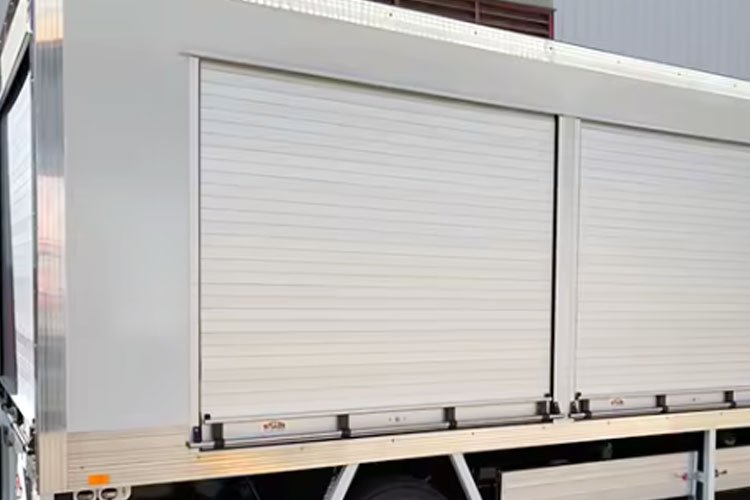
¿Qué tipos de puertas enrollables existen para camiones caja?
Los camiones caja presentan dos tipos de accionamiento: puertas enrollables manuales y puertas enrollables eléctricas. Las opciones de material incluyen aleación de aluminio, acero galvanizado y acero inoxidable.
Diferencias entre puertas enrollables manuales y eléctricas:
Puertas enrollables manuales
Las puertas enrollables manuales se basan en sistemas de carriles y muelles de torsión para permitir un empuje o arrastre manual sencillo y rápido. Adecuadas para furgonetas pequeñas y medianas, ofrecen un mantenimiento relativamente sencillo y costes más bajos. Sin embargo, requieren un accionamiento manual para abrirlas y cerrarlas, lo que reduce su eficacia.
Puertas enrollables eléctricas
Las puertas enrollables eléctricas incorporan motores, mandos a distancia y sistemas de control inteligentes. Los operarios sólo tienen que pulsar un botón o utilizar el mando a distancia para la apertura/cierre automáticos, lo que aumenta considerablemente la comodidad. Suelen utilizarse en camiones grandes, vehículos refrigerados de gama alta, vehículos especializados y aplicaciones que requieren un uso frecuente.
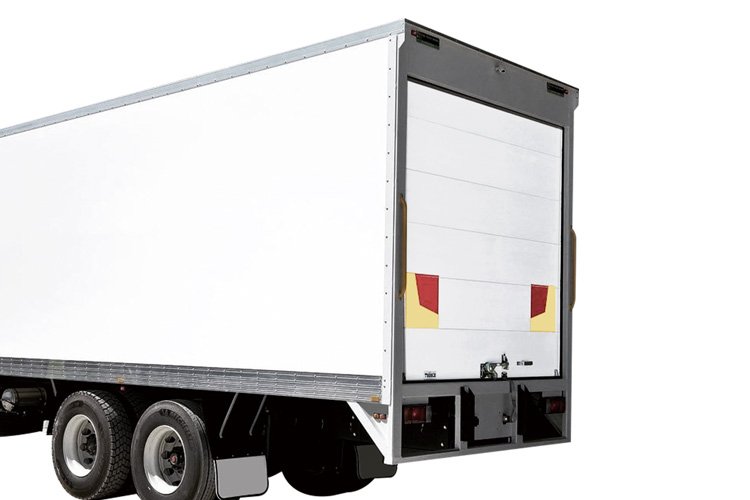
Por clasificación de materiales:
- Aleación de aluminio Puertas enrollables: Ligeras, resistentes a la corrosión y de bajo mantenimiento, ideales para entornos costeros y húmedos o para operaciones frecuentes de carga y descarga.
- Puertas enrollables de acero galvanizado: Gran solidez y resistencia a los impactos, adecuado para el transporte pesado y a granel, y para asegurar cargas de gran valor. Desventaja: mayor peso.
- Puertas enrollables de acero inoxidable: Excepcional resistencia a la corrosión pero mayor coste, se utiliza principalmente en entornos extremos o en vehículos que requieren durabilidad a largo plazo.
- Puertas enrollables de material compuesto: Como los paneles sándwich de espuma, que combinan ligereza, robustez y algunas propiedades aislantes, adecuados para camiones frigoríficos y transporte especializado.
En los siguientes apartados se detallarán las características de las puertas enrollables fabricadas con distintos materiales.
¿Cuáles son los componentes de una puerta enrollable?
Una puerta enrollable para camiones consta de 13 componentes, cada uno de los cuales cumple una función única. Juntos, garantizan que todo el sistema de la puerta enrollable funcione sin problemas.
| Componente | Descripción de la función |
| Final de carrera | Restringe el recorrido de la puerta para evitar el rebasamiento, salvaguardando los equipos y la seguridad de las personas. |
| Viga inferior | Refuerza la rigidez y las juntas de la parte inferior de la puerta, aumentando la integridad estructural |
| Muelle de torsión | Compensa el peso de la puerta para un funcionamiento suave y sin esfuerzo |
| Sistema de cierre | Bloquea la puerta para evitar robos y asegurar la carga |
| Paneles de puerta (lamas) | Se entrelazan para formar una cortina flexible, se enrollan en el tambor superior |
| Burlete/Sello | Bloquea la lluvia, el polvo y el aire frío para preservar las condiciones interiores |
| Sistema de tambor y cable | Eleva puertas pesadas de forma sincronizada, distribuyendo uniformemente la carga de paneles |
| Eje | Soporta todo el peso de la puerta, uniendo el tambor y el conjunto de muelles |
| Panel de control/Remoto | Permite el control remoto o local de la puerta eléctrica con opciones de modo |
| Carril guía | Mantiene la cortina en trayectoria vertical, eliminando balanceos o atascos. |
| Pista | Dirige los paneles en suave deslizamiento vertical para un movimiento fiable |
| Accionamiento del motor | Activa el movimiento automático de la puerta con temporización opcional |
| Cortina óptica de seguridad | Detecta obstáculos abajo y se detiene al instante para evitar aplastamientos |
¿Cómo instalar una puerta enrollable para camiones Box?
La instalación de una puerta enrollable para camiones caja es relativamente complicada y requiere la orientación de un profesional para mayor seguridad. No sólo la colocación debe ser precisa, sino que el sellado también debe ser seguro. Una instalación incorrecta puede provocar atascos, un sellado deficiente y otros problemas. El proceso de instalación consta de 7 pasos.
- Coloque el pestillo: Coloque el pestillo pequeño dentro de la barra inferior, a 10-15 cm de cada lado.
- Marca los agujeros: Presione el pestillo contra la barra inferior y marque con un bolígrafo las posiciones para los dos orificios de los tornillos.
- Taladre agujeros piloto: Con un taladro eléctrico, perfore dos orificios de 3 mm de profundidad en los puntos marcados. No taladre a través.
- Asegure el pestillo: Utilice los dos tornillos de cabeza cuadrada y las tuercas incluidos para fijar firmemente el pestillo a la barra inferior.
- Instale la placa de cierre: Cierre la puerta y observe dónde entra en contacto el pestillo con el marco. Coloque la placa del pestillo en ese punto, marque y taladre los agujeros y fíjela con los mismos tornillos.
- Operación de prueba: Abra y cierre la puerta para asegurarse de que el pestillo se desliza suavemente en el cerradero. Si se engancha, ajuste ligeramente la posición.
- Bloqueo: Para asegurar la bicicleta, basta con pasar un candado estándar (se adquiere por separado) por el pequeño orificio del cierre.
¿Cómo mantener las puertas enrollables para camiones?
Para garantizar un funcionamiento estable a largo plazo de las puertas enrollables para camiones caja, manteniendo un rendimiento suave y sin daños, siga estos 7 métodos para mantenerlas funcionando correctamente.
1: Limpiar los paneles de la puerta y el polvo del carril
Limpie regularmente las superficies, los paneles de las puertas y los rieles con un paño suave. Presione suavemente. No utilice nunca paños húmedos, ya que aumenta el riesgo de oxidación.
2: Lubricar las piezas móviles
Aplique periódicamente lubricante a las orugas, rodillos, cojinetes y otros componentes móviles para evitar el desgaste causado por la fricción.
3: Inspeccionar los pernos de fijación y las juntas
Apriete periódicamente con herramientas los pernos de los puntos críticos, como los paneles de las puertas, los largueros inferiores y los carriles guía, para evitar traqueteos o fallos de funcionamiento causados por el aflojamiento.
4: Mantenimiento del sistema de impermeabilización
Compruebe si las tiras de sellado están envejecidas o dañadas, y sustituya rápidamente los componentes desgastados para mantener la eficacia del sellado de la puerta y evitar la entrada de humedad.
5: Inspección del muelle de torsión y del sistema elástico
Inspeccione los muelles de torsión en busca de fallos o deformaciones. Sustitúyalos cuando sea necesario para garantizar un funcionamiento sin esfuerzo y eliminar los riesgos de seguridad.
6: Prevención de la oxidación y la corrosión
Especialmente para las puertas de acero, aplique periódicamente pintura antioxidante y tratamientos anticorrosión para evitar el deterioro de la estructura metálica por el agua de lluvia y los productos químicos.
7: Mantenimiento de cerraduras y dispositivos de seguridad
Compruebe periódicamente el funcionamiento de la cerradura para evitar atascos o roturas, garantizando la seguridad y la prevención de robos.
Comparación de distintos materiales
| Material | Ventajas | Desventajas | Aplicaciones típicas |
|---|---|---|---|
| Aleación de aluminio | Ligero para una mayor eficiencia de combustible; altamente resistente a la corrosión; de bajo mantenimiento y estéticamente agradable. | Propenso a abolladuras y arañazos; menor seguridad y resistencia a los impactos. | Operaciones frecuentes; entornos costeros/húmedos; reparto y logística ligeros |
| Acero galvanizado | Excepcional solidez y resistencia a los impactos; seguro y duradero para usos intensivos | Más pesado, lo que reduce la carga útil; propenso a la oxidación; mayores necesidades de mantenimiento. | Transporte de carga pesada; industrias robustas como la construcción; entrega segura |
| Acero inoxidable | Excelente resistencia a la corrosión; gran durabilidad y bajo mantenimiento a largo plazo | Más caro; más pesado que el aluminio; requiere una limpieza ocasional | Entornos corrosivos agresivos; operaciones de larga duración como transporte de alimentos/médico; industrias de primera calidad |
| Materiales compuestos (paneles sándwich) | Ligero con resistencia y aislamiento térmico; resistente a la corrosión y personalizable | Mayor coste; menos resistente a los impactos que el acero; reparaciones complejas | Vehículos refrigerados/cadena de frío; carga sensible a la temperatura; usos especializados como vehículos recreativos. |


 English
 French
 German
 Japanese
 Korean
 Russian
 Polish
 Spanish