
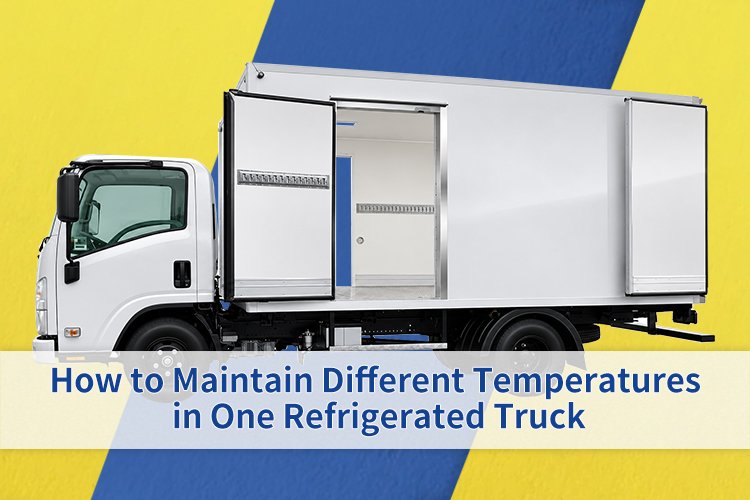
Cómo mantener diferentes temperaturas en un camión frigorífico
Why Do Refrigerated Trucks Need Multiple Temperature Zones?
Transporting different types of temperature-sensitive products in the same transport truck can be a challenge. Fresh meat, frozen seafood, dairy products, fruits and vegetables each have different storage temperature requirements. If each type of product is equipped with separate refrigerated trucks, it will not only increase transportation costs, but also reduce operational efficiency.
Multi-temperature zone refrigerated trucks provide a practical solution: by dividing the compartment into several independent temperature zones, different temperatures can be controlled. However, to ensure temperature stability in each temperature zone, it is not enough to install partitions alone. Refrigeration systems, insulation, airtight seals, and proper airflow management all play a vital role.
This article will explore how to control different temperatures within the same refrigerated truck and what factors manufacturers should consider when designing efficient multi-zone trucks.
How Does a Multi-Temperature Refrigerated Truck Work?
Multi-temperature refrigerated vehicle bodies utilize partitions—which may be either movable or fixed—to create distinct temperature zones. Each compartment can be set to and maintained at a specific temperature tailored to the requirements of the cargo it carries.
For instance, a refrigerated vehicle might include: a section for frozen foods (maintained at -18°C or below), a section for fresh meat (kept between 0°C and 4°C), and another section designed for products that require a higher storage temperature.
This system generally relies on three key components:
- Separate temperature zones: Insulated partitions are used to separate different cargo areas, thereby minimizing heat exchange.
- Refrigeration system: Multiple evaporators or other suitable refrigeration configurations are employed to provide cooling to each individual compartment.
- Temperature monitoring: Sensors measure the temperature in each zone in real time, allowing operators to track environmental conditions and promptly detect any irregularities.
The configuration of the refrigeration system must be aligned with the vehicle body layout, cooling load requirements, and the intended temperature ranges.
Key components for temperature control in Truck Bodies
· High-Performance Insulation Panels
Insulation panels help minimize heat transfer between individual compartments, as well as between the external environment and the interior of the cargo space.
Fiberglass-reinforced plastic (FRP) sandwich panels are widely used in the construction of refrigerated vehicle bodies. They typically consist of FRP face sheets bonded to an insulating core material, such as XPS, PET, or polyurethane foam.
This combination results in a lightweight structure that offers excellent thermal insulation, moisture resistance, and durability. Customers can select the appropriate panel thickness and core material based on the vehicle’s design and specific operational requirements.
· Refrigeration Units and Air Circulation
Refrigeration equipment provides the necessary cooling for each compartment. Depending on the vehicle configuration, systems such as multi-evaporator setups or other independent refrigeration solutions may be employed.
Effective air circulation is also critical. Cold air must be able to circulate thoroughly throughout each compartment without being obstructed by cargo or internal structures. If air circulation is restricted, it can lead to uneven temperatures, even when the refrigeration system is functioning correctly.
· Temperature Sensors and Monitoring Systems
Temperature sensors enable operators to monitor each compartment independently. Modern monitoring systems provide real-time temperature displays, log historical data, and trigger alerts if temperatures fall outside of pre-set ranges.
This allows drivers and fleet managers to respond promptly to any temperature deviations.
How can heat transfer between different temperature zones be prevented?
In multi-temperature refrigerated transport, preventing unnecessary heat exchange is one of the most critical challenges.
- Use highly efficient thermal partitions
Select thermal insulation panels with appropriate thermal properties and thickness. The insulation core material should remain as continuous as possible to minimize the “thermal bridge” effect. - Ensure airtightness
Gaps along the edges of partitions, around doors, or at the joints between panels can allow warm external air to enter and cold internal air to escape. Using suitable sealing materials and carefully designing the connection structures helps maintain temperature stability. - Minimize air exchange between compartments
Frequent opening of partition doors disrupts temperature balance. Implementing well-designed door structures and operational procedures helps reduce unnecessary air exchange. - Recommended temperature settings for different types of cargo
Different products require different transport conditions. The values provided below serve as general reference ranges; however, actual requirements depend on the specific product type, regulatory standards, and transit duration.
| Tipo de carga | Typical Temperature Range |
|---|---|
| Frozen meat | -18°C or below |
| Frozen seafood | -18°C or below |
| Carne fresca | 0°C to 4°C |
| Productos lácteos | 2°C to 6°C |
| Fresh fruits | Depends on fruit variety |
| Fresh vegetables | Depends on vegetable variety |
Before transport, operators should verify the specific temperature requirements for each product and configure the compartments accordingly.
- Best Practices for Maintaining Stable Temperatures
Even a well-designed refrigerated vehicle requires proper operation to maintain a stable temperature.
- Pre-cool the cargo space: Cool each compartment to the target temperature before loading cargo.
- Organize cargo appropriately: Place different types of products into their designated temperature zones.
- Ensure air circulation: Avoid blocking air vents and return-air channels.
- Minimize door openings: Reduce the frequency and duration of opening doors during loading and unloading.
- Monitor temperatures regularly: Check the temperature in each compartment throughout the entire transport process.
- Inspect insulation and seals: Promptly repair any damaged panels, joints, or door seals.
- Avoid overloading: Leave sufficient space to ensure effective circulation of cold air.
These measures help reduce temperature fluctuations and protect temperature-sensitive products during transport.
Conclusión
Maintaining different temperatures within a single refrigerated vehicle requires the coordination of refrigeration, thermal insulation, airflow, and temperature monitoring. Independent temperature zones, well-sealed partitions, appropriate insulation materials, and a properly configured cooling system are essential for reliable cold-chain transport.
For manufacturers of refrigerated truck bodies, selecting the right panel and partition structures is a critical step toward enhancing thermal insulation, reducing vehicle weight, and ensuring long-term durability.
Composite-Box offers customized, modular panel systems and multi-temperature zone solutions, helping clients develop efficient, lightweight, and durable multi-temperature refrigerated truck bodies.



 English
 French
 German
 Japanese
 Korean
 Russian
 Polish
 Spanish