
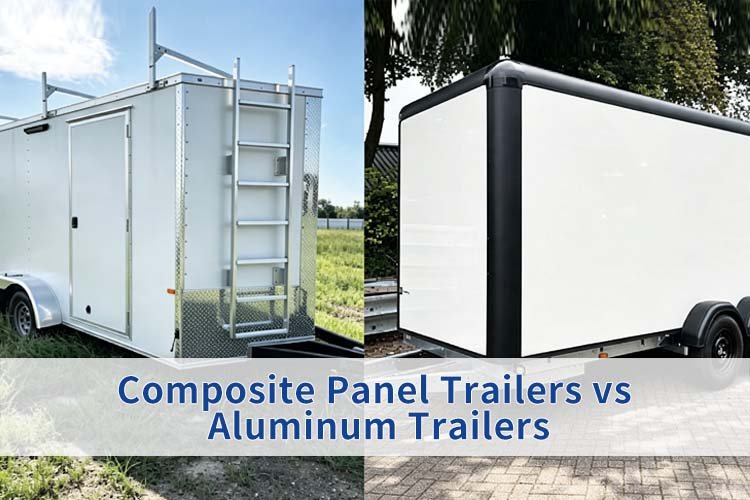
Composite panel Trailers vs Aluminum Trailers
Industry Background
Aluminum trailers have long dominated the market, yet they entail high maintenance costs, lack energy efficiency, and are unsuitable for transporting temperature-sensitive cargo. Trailer manufacturers have been seeking new materials that are lighter, more durable, and more energy-efficient. Consequently, composite trailers have emerged to meet this demand, experiencing rapid growth in recent years.
What Is a Composite Material Trailer?
Composite trailers are trailers constructed from composite materials. The panels used for these trailers typically consist of high-strength fiberglass-reinforced plastic (FRP) or continuous fiber-reinforced thermoplastic (CFRT) sheets bonded to a lightweight core material—such as PET, PU, XPS, or PVC foam, or PP honeycomb panels.
Composite panel Trailers vs Aluminum Trailers: Side-by-Side Comparison
| Feature | Composite Panel Trailer | Aluminum Trailer |
| Weight | Lighter | Light |
| Thermal Insulation | Excellent | Poor |
| Strength-to-Weight | Excellent | Good |
| Corrosion Resistance | Excellent | Very Good |
| Dent Resistance | Better | Moderate |
| Maintenance | Low | Medium |
| Noise Reduction | Excellent | Poor |
| Fuel Efficiency | Higher | Good |
| Initial Cost | Higher | Lower |
| Lifecycle Cost | Lower | Higher |
Thermal Insulation Comparison
Thermal insulation performance is one of the key differences between composite panel trailers and aluminum trailers. While aluminum is lightweight and durable, it is also highly thermally conductive, allowing heat to transfer rapidly. In contrast, composite panels feature an insulating core material that significantly reduces heat transfer, helping to maintain a stable internal temperature.
Composite panel trailers are the preferred choice for refrigerated transport, cold chain logistics, pharmaceutical shipping, and food distribution. Their superior thermal insulation helps maintain a constant temperature, lower energy consumption, and reduce long-term operating costs, giving them an efficiency advantage over traditional aluminum trailers.
Cost Comparison: Initial Cost vs Total Cost of Ownership
Initial Cost
In terms of initial purchase cost alone, traditional aluminum trailers hold the advantage due to lower raw material costs. If you do not have specific requirements regarding fuel efficiency or the trailer’s service life, an aluminum trailer is also a good choice.
Long-Term Cost
In short, the long-term cost of composite trailers is far lower than that of aluminum trailers. They are durable, fuel-efficient, easy to repair, and have a longer service life.
Applications for Composite Trailers
·Refrigerated transport
Rapid transport and the preservation of quality and freshness are paramount in refrigerated transport. Composite-material trailers offer excellent thermal insulation, making them an ideal choice for transporting refrigerated goods.
·Dry freight transport
Trailers made of composite panels are lightweight and offer superior fuel efficiency, allowing for the transport of a larger volume of dry cargo per trip.
·Mobile medical units
Medical shipments often have stringent requirements regarding the transport environment; trailers constructed from composite panels can precisely control the temperature and humidity inside the cargo compartment, thereby ensuring the quality of the pharmaceuticals.
·Livestock trailers
Transporting livestock requires special attention to the animals’ health, and in some cases, constant temperature and humidity; however, traditional aluminum trailers perform only adequately in this regard.
·RV trailers
RV trailers made of composite panels offer temperature control, lighter weight, and higher fuel efficiency, providing a superior user experience.
FAQ
Is a composite trailer stronger than aluminum?
Aluminum has high structural strength, which is why traditional metal trailers are mostly made of aluminum. Composite material trailers, on the other hand, offer a longer service life due to their superior structural performance.
Do composite trailers rust?
Composite trailers do not rust, making them an excellent choice for applications that prioritize long-term durability and reduced maintenance costs.
Are composite trailers more expensive?
Yes. In terms of initial cost, composite trailers are indeed more expensive; however, their lower maintenance costs and longer service life result in superior cost-effectiveness.
Which trailer lasts longer?
They are definitely composite trailers. They are waterproof, moisture-resistant, and corrosion-resistant, offering a long service life. Their advantages are particularly pronounced in harsh environments.
Are composite trailers recyclable?
Yes. Composite trailers are often made from recyclable materials such as thermoplastic composites and PET foam. They are more environmentally friendly.
Which material is better for refrigerated trailers?
For refrigerated trailers, we recommend XPS or PU foam cores to provide superior thermal insulation.
Does a composite trailer improve fuel economy?
Yes. Compared to traditional metal trailers, composite trailers are lighter in weight, which increases cargo capacity and improves fuel efficiency.
Can composite trailers be repaired easily?
Minor damage to the composite trailer can be repaired in-house. Additionally, our modular design makes body repairs and replacements faster and more convenient.
What core materials are used in composite trailers?
Common core materials include PET foam, PU foam, XPS foam, PVC foam, and PP honeycomb; the specific choice depends on your requirements regarding thermal insulation, strength, weight, and application needs.
Why are logistics companies switching to composite trailers?
Efficiency and operating costs are paramount in the logistics transport sector. Naturally, logistics companies favor composite-material trailers, as they are lighter, require less maintenance, and offer a longer service life.

 English
 French
 German
 Japanese
 Korean
 Russian
 Polish
 Spanish